Shelagh Willet passed away

Our much-loved Friend, Shelagh Willet of Botswana Monthly Meeting passed away on Monday 8 June at Bamalete Lutheran Hospital where she was admitted over the previous weekend.

She will be laid to rest on Saturday 20 June with a preceding service on Friday 19 June at 2:30pm at the Gabane Kgotla.

Posted in Quaker community | Leave a comment

Quaker Action, Summer 2015 edition

The Summer 2015 edition of Quaker Action, from the American Friends Service Committee, includes AFSC-funded work in Zimbabwe. Have a look at it by clicking here: http://afsc.org/story/beyond-charity-toward-justice

Posted in Newsletters, World community | Leave a comment

Quaker Faith & Practice, 5th edition

The fifth edition of Quaker faith & practice, the book of Christian discipline of the Yearly Meeting of the Religious Society of Friends (Quakers) in Britain, is now available and can be accessed online at no charge by following this link: http://qfp.quaker.org.uk/

Should you wish to purchase a printed copy, there are links on that web page for you to do so.

Posted in Publications | Leave a comment

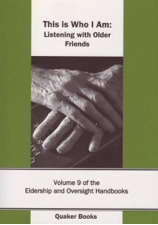
Book Review: This is Who I Am: Listening with Older Friends

Book-This is who I amVolume 9 of the Eldership and Oversight Handbooks, Quaker Books, London, 2004

Book Review by Rory Short, Johannesburg Monthly Meeting — April 2015

The book is aimed at helping older Friends grapple with the fact that they are aging, i.e. drawing steadily closer to death, and what this means for them in terms of changes both as physical and spiritual beings. These changes are not catalogued as such but are touched on throughout the text as the difficulties and rewards of actively listening to an older person are covered.

Its central tenet seems to be that older persons need people to share their experience with in order to help them to ingest these experiences both past and present. To this end the last section of the pamphlet is devoted to sensitively exploring the conditions that are necessary for creating a good one-on-one listening environment for the older person as the person being listened to.

The book focuses on the idea of establishing a Meeting for Listening within our worshiping communities as a context within which older Friends will experience the material and spiritual companionship that they might otherwise feel that they lack.

The book seems to be written from the perspective of the members of larger Meetings in Britain where the Meeting as a whole rolls along on the crest of the standing wave of generations. In Johannesburg this is not the case. JMM is sliding down the generational slope as the majority of our worshiping members are in our 70‘s. It is thus difficult for us to lay down the mechanical logistical roles in the Meeting as there are just too few younger people able to step into them. This is not to say that Meetings for Listening would not be appropriate but that the listeners would inevitably have to be ourselves, the older Friends. We are facing a different situation compared to someone in a Meeting that embraces both young and old. It is nevertheless worth reading through this pamphlet if only to see that as an older Friend you are not alone in your experience.

— Rory Short

Posted in Book Review | Leave a comment

Book Review: Black Fire — African American Quakers on Spirituality and Human Rights

Book-Black FireReviewed by Sam Mugambe, Johannesburg Monthly Meeting — 18 May 2015

When I started reading this book “Black Fire: African American Quakers on Spirituality and Human Rights”, I expected to read about Quakers in America. But most of this book is about Human Rights, and this is what Quakers are advocating for.

So you cannot separate Quakers from Human Rights. This book explain how many learned Quakers are teaching us that oppressing one another is the mindset of both the oppressor and the oppressed. This needs to be corrected by educating one another, so that we can be liberated both physically and mentally.

In Chapter V, when I was reading about Barrington Dunbar on page 131, I was impressed by what Malcom X said about Christians, “ You cannot call yourself a Christian when you are you are practicing segregation; you are a devil.”

This book “Black Fire” is a good source of information for every one young and old, white and black who desire to educate a new generation how to live as brothers and sisters, with no color prejudice.

— Sam Mugambe

Posted in Book Review | Leave a comment

Epistle from the Quakers in Britain Yearly Meeting

You can get to the Quakers in Britain website to view all the documents from YM by clicking here: http://www.quaker.org.uk/ym

Or you can download the Epistle directly by clicking here: http://www.quaker.org.uk/sites/default/files/YM-Epistle-2015.doc

Posted in World community, Yearly Meeting | Leave a comment

Statement on Xenophobic Violence in South Africa

28 April 2015

PRESS STATEMENT BY THE SOCIETY OF FRIENDS IN CENTRAL AND SOUTHERN AFRICA YEARLY MEETING (QUAKERS)

Statement on Xenophobic Violence in South Africa

The Central and Southern Africa Yearly Meeting of the Religious Society of Friends (Quakers) is deeply troubled by the violence aimed at foreign nationals that is spreading throughout South Africa.

South Africa has a terrible history of disrespecting African people. Historically the white minority population used its political power to disrespect and violate the human rights of black South Africans in ways that were violent and brutal. Apartheid was, fundamentally, a legal policy of Afrophobia that dehumanised black South Africans. We are therefore deeply saddened that some South Africans are turning on fellow human beings in ways that are also violent and brutal. Violence has never produced peace; it has simply bred counter-violence.

Our view is that the root cause of this wave of violence is desperation. This includes desperation at a lack of opportunities and jobs, desperation at grinding poverty, desperation at the lack of housing, healthcare and other services, and general desperation at the lack of social justice 21 years on from the end of Apartheid.

This desperation around jobs and poverty affects South Africa’s neighbours as deeply as it affects South Africa, whose economy is crucially linked with that of its neighbours, and the wider continent. It is a desperation that is entirely understandable, but attacking fellow humans will never remove the root causes of suffering in our society.

We call on all South Africans to consider deeply the root causes of poverty and desperation in our country and we call on all leaders, particularly political ones, to:

  • Clearly and unequivocally stand against any kind of violent action against all fellow human beings;
  • Take concrete steps to ensure an outbreak of this kind of violence does not happen again;
  • Ensure that those responsible for perpetrating violent attacks are brought to justice, including those who have engaged in hate speech to incite such attacks;
  • Address the root causes of desperation among poor people in South Africa which result in misdirected anger at innocent people, including:
      • acting speedily to rid the country of the corruption which is draining the public purse,
      • ensuring the progressive roll-out of public services to poor people,
      • addressing our economic crisis which has resulted in high unemployment levels,
      • providing vocational training to address the unemployment problem,
      • reducing economic inequality which has been shown to undermine social cohesion.

Quakers have a 250-year-old peace testimony and firmly believe that there is “that of God” in every human being. In our view, this violence does nothing to build South Africa or to increase South Africans’ hopes of a better life for all. It needs to stop. Forever.

THE END

Quakerism is a way of life rooted in a transforming experience of the Divine. From this we seek to live out our principles of truth, peace, simplicity and equality, recognising that of God in everyone. Our meetings offer a place of welcome, encounter and spiritual exploration. Quakers are also called “The Society of Friends”.

The Central and Southern Africa Yearly Meeting unites Quakers in Botswana, Lesotho, Namibia, South Africa, Zimbabwe and Zambia.

Contact person: Helen Holleman, Yearly Meeting Clerk, mobile phone number: 079 227 9698, e-mail: helenholleman807@gmail.com

Posted in Ethics, Position Statements | Leave a comment

Quakers: The faith forgotten in its hometown

It was the faith of two US presidents and several prominent UK industrialists, yet the origins of the Quaker religion are little known today by people living in the English town where it began. However, a new heritage trail targeting the American tourist market is aiming to change that.

In 1647, George Fox, a cobbler, was walking past a church in the East Midlands when he received what he described as a message from God.

The son of a Leicestershire church warden, he had spent years wandering around an England torn apart by civil war and increasingly disaffected with the establishment church.

The vision of Christianity he received outside the church in Mansfield, Nottinghamshire, was deeply radical – God was within everyone and there was no need for priests.

Within a few years, he was preaching to large crowds – and provoking the persecution of the authorities who felt threatened by his anti-priesthood agenda.

“He was fed up with preachers and professionals setting standards, leaving out the poorest people,” said Ralph Holt, a historian.

“He couldn’t see how someone could go to college and get a certificate and come back somewhere between this land and God.”

Read the rest of the article on the BBC website.

Posted in Quaker history, World community | Leave a comment

Award-winning Mozambican Author Mia Couto’s Open Letter to Jacob Zuma on Xenophobia Crisis: “We Remember You in Maputo”

Mozambican author Mia Couto has written an open letter to Jacob Zuma concerning the current xenophobic violence in South Africa.

Couto received the prestigious 2014 Neustadt International Prize for Literature, becoming the first Mozambican author to be honoured with the title, and was recently announced as a finalist for the 2015 Man Booker International Prize.

Paul Fauvet, the editor of the Mozambique News Agency, shared a translation of Couto’s open letter in a public post on Facebook.

Read the letter:

Open Letter from the Chairperson of the “Fernando Leite Couto Foundation”, Mia Couto

To: His Excellency President Jacob Zuma

We remember you in Maputo, in the 1980s, from that time you spent as a political refugee in Mozambique. Often our paths crossed on Julius Nyerere Avenue and we would greet each other with the casual friendliness of neighbours. Often I imagined the fears that you must have felt, as a person persecuted by the apartheid regime. I imagined the nightmares you must have experienced at night when you thought of the ambushes plotted against you and against your comrades in the struggle. But I don’t remember ever seeing you with a bodyguard. In fact it was we Mozambicans who acted as your bodyguards. For years we gave you more than a refuge. We offered you a house and we gave you security at the cost of our security. You cannot possibly have forgotten this generosity.

We haven’t forgotten it. Perhaps more than any other neighbouring country, Mozambique paid a high price for the support we gave to the liberation of South Africa. The fragile Mozambican economy was wrecked. Our territory was invaded and bombed. Mozambicans died in defence of their brothers on the other side of the border. For us, Mr President, there was no border, there was no nationality. We were all brothers in the same cause, and when apartheid fell, our festivities were the same, on either side of the border.

For centuries Mozambican migrants, miners and peasants, worked in neighbouring South Africa under conditions that were not far short of slavery. These workers helped build the South African economy. There is no wealth in your country that does not carry the contribution of those who today are coming under attack.

For all these reasons, it is not possible to imagine what is going on in your country. It is not possible to imagine that these same South African brothers have chosen us as a target for hatred and persecution. It is not possible that Mozambicans are persecuted in the streets of South Africa with the same cruelty that the apartheid police persecuted freedom fighters, inside and outside the country. The nightmare we are living is more serious than that visited upon you when you were politically persecuted. For you were the victim of a choice, of an ideal that you had embraced. But those who are persecuted in your country today are guilty merely of having a different nationality. Their only crime is that they are Mozambicans. Their only offence is that they are not South Africans.

Mr President, the xenophobia expressed today in South Africa is not merely a barbaric and cowardly attack against “the others”. It is also aggression against South Africa itself. It is an attack against the “Rainbow Nation” which South Africans proudly proclaimed a decade or more ago. Some South Africans are staining the name of their motherland. They are attacking the feelings of gratitude and solidarity between nations and peoples. It is sad that your country today is in the news across the world for such inhuman reasons.

Certainly measures are being taken. But they are proving inadequate, and above all they have come late. The rulers of South Africa can argue everything except that they were taken by surprise. History was allowed to repeat itself. Voices were heard spreading hatred with impunity. That is why we are joining our indignation to that of our fellow Mozambicans and urging you: put an immediate end to this situation, which is a fire that can spread across the entire region, with feelings of revenge being created beyond South Africa’s borders. Tough, immediate and total measures are needed which may include the mobilization of the armed forces. For, at the end of the day, it is South Africa itself which is under attack.

Mr President, you know, better than we do, that police actions can contain this crime but, in the current context, other preventive measures must be taken. So that these criminal events are never again repeated.

For this, it is necessary to take measures on another scale, measures that work over the long term. Measures of civic education, and of exalting the recent past in which we were so close, are urgently needed. It is necessary to recreate the feelings of solidarity between our peoples and to rescue the memory of a time of shared struggles. As artists, as makers of culture and of social values, we are available so that, together with South African artists, we can face this new challenge, in unity with the countless expressions of revulsion born within South African society. We can still transform this pain and this shame into something which expresses the nobility and dignity of our peoples and our nations. As artists and writers, we want to declare our willingness to support a spirit of neighbourliness which is born, not from geography, but from a kinship of our common soul and shared history.

Maputo, 17 April 2015
Mia Couto

Sourced from Books Live website at http://bookslive.co.za/blog/2015/04/20/award-winning-mozambican-author-mia-coutos-open-letter-to-jacob-zuma-on-xenophobia-crisis-we-remember-you-in-maputo/

Posted in Ethics, Position Statements, World community, World issues | Leave a comment

Friends Journal (USA) and The Friend (UK)

The US-based Friends Journal is published by Friends Publishing Corporation to serve the Quaker community and the wider community of spiritual seekers through the publication of articles, poetry, letters, art, and news that convey the contemporary experience of Friends.

The website of the Friends Journal is here: Friends Journal

The UK-based The Friend provides weekly news, features, personal stories, arts, humour and friendship. It helps Friends keep up to date with contemporary Quaker thought and action.

The Friend is based in Britain and is published weekly. The editorial office is in London.  It is completely independent from Britain Yearly Meeting and is owned by The Friend Publications Ltd, a charity that also publishes the Friends Quarterly. The trustees of the Friend are appointed from members of Britain Yearly Meeting and they hold their post for three years.

The website of The Friend is here: The Friend


Posted in Newsletters, World community | Leave a comment