Worship in the Facebook age

The Huffington Post carried an excellent article by Philip Gulley, a Quaker Pastor and author in the US. He addresses the dichotomy of challenging but also loving in and age where we have to be our own censors.

[Harry Emerson] Fosdick said the Christian church should “be a fountainhead of a better social order’’ and that “any church that pretends to care for the souls of people but is not interested in the slums that damn them, the government that corrupts them, and the economic order that cripples them is a dry, passive do-nothing religion in need of new blood.’’ Fosdick had a habit of putting the hay down where the goats could get it.

Click the link below to read the full article.

http://www.huffingtonpost.com/philip-gulley/worship-in-the-facebook-age_b_14645628.html

Philip Gulley is a Quaker pastor, speaker and author of 21 books. His bodies of work encompass progressive Christian theology, fiction, essay and memoir. He writes a monthly column for Indianapolis Monthly and is a regular contributor to The Saturday Evening Post.

Posted in Ethics, Modern living, Quaker community | Leave a comment

Friends of Monze update

Deana went to Monze, a small town of 19,000, in Southern Zambia, where she lived within the local community doing much the same work as she did as a health visitor in Port Talbot. Seeing people in their own homes had a big impact on her. Knowing too that 400 children -nearly half of them AIDS orphans – walked many miles to a building which looked like a dilapidated cowshed, which served as a school made Deana determined to do something.  So when she was asked by the people to help Deana said “How can I say no?”

On returning home she was greatly supported by Bridgend Quakers who helped her to set up a registered charity and serve on the board of trustees. The vision was always that to be effective in alleviating poverty, there must be a collaborative partnership, where we in Bridgend work with groups already helping to develop their communities. The people of Monze must be at the forefront of any development, which is why work must focus on empowerment with skills in agriculture, business and education.

This is what has been achieved already (Feb 2017):

  • We received a Quaker Peace and Social Witness grant for a solar water pump and goats to help Cisikili HIV support group grow vegetables to support orphans.
  • We rebuilt Lushomo school 3 classrooms, solar lighting, books, 2 compost toilets, showers for girls, a bore hole, solar waterpump providing clean water for the commmunity and garden, sports equipment and drums, design, training and trees for a school permaculture garden, fence.
  • Small businesses have been set up, including buying a peanut butter machine to enable a group to use their crop of peanuts to make and sell peanut butter. Income is used to support a pre-school 3 to 7 year olds, care for the elderly and enable orphans to attend school. Another small business is an egg laying project run by a womens support group, the eggs provide good protein for the community and income helps children with disabilities and run a school for 3 to 7 year olds.
  • Training to build solar cookers out of cardboard.
  • Training to make supportive furniture for children with disabilities out of cardboard.
  • Sponsoring deprived children to attend school, and providing solar lights to do their homework.

Friends of Monze Update February 2017

We are delighted to tell you that Kampunu School, the second school that Friends of Monze has built in Monze, was completed on 13th January, just in time for the start of the new term on January 16th. Our partners Zambia Women and Girls Foundation (ZWaGF) have inspected the school and given it a good report. Everyone is looking forward to the handover ceremony to be celebrated in April.

130 children have already enrolled with more expected. Kampunu School, built in a poor rural part of Monze was a real team effort. The villagers in Kampunu hand made the 12,000 bricks for the school, and did much of the labouring overseen by Stanley the trusted builder, who had already proved himself when building Lushomo School. We drilled a bore hole to provide water for hygiene and   garden taps.  We have QPSW funding for permaculture gardening training,  a fence to keep wandering cattle away, tools and fruit trees for this garden.

We are now looking for funding for books to cover the 8 subjects in the Zambian curriculum which children study each year.

Recently, our partners in Zambia have identified a third school for us to consider, way out in the bush, in a very poor area in Monze. Parents are very keen for a proper school building to replace the inadequate classrooms they have built themselves.

We are pleased to say that we have provide Sichiyanda School with 2 computers and teaching material for grade 9 exam work.  We have provided permaculture training, a bore hole and hand pump. We erected a fence which will be planted with brambles to keep goats out of the permaculture garden.

We are planning to put on a 2 day training on Menstrual Hygiene Matters (MHM). The education will be provided for 2 groups of women. One group are peer educators, energetic young women who will teach through the medium of drama and dance to children in schools and youth clubs. The other group are Dorcas Mothers, a group of Seven Day Adventist Church ladies, who will teach women’s groups about MHM. They will also be sewing menstrual pads which they can sell. FoM want to donate one free pad to each school girl who is part of the MHM training.

A group of women in Hampshire run a social enterprise training people in Zambia to build cardboard frames and chairs which help keep disabled children upright, and able to leave their huts. They visited Monze last June and worked with Deana and are planning to complete the training in March when they next visit.

Deana, as ever, is very busy and in contact by WhatApp and Skype with our partners in Monze on an almost daily basis. She has received a large consignment of beautiful hand -made baskets to sell through shops or stalls, so pleased contact her if you know of any venue where she can sell these. She is also more than happy to speak to schools or organisations of any kind about the charity and the amazing work it does.

www.friendsofmonze.org

Posted in Quaker community, Uplift and outreach | Tagged , , , , , , , , , , , , , , | Leave a comment

Quakers stand alongside victims of racist policies

Further to the item on forced migration carried in Quaker News 97 (and shared on this site last week), Ekklesia has published the following item. Ekklesia is an independent, not-for-profit thinktank which orients its work around the changing role of beliefs, values and faith/non-faith in public life.

By agency reporter
FEBRUARY 5, 2017

Quakers in Britain have responded to the global unease about recent political developments around the world with a clear statement asserting: “Humanity needs leaders of integrity and conscience, ready to be held to account by individuals and institutions, national and international.”

In the statement made yesterday ( 4 February 2017) by their representative body, Meetings for Sufferings, Quakers say, “There can be no peace without justice; no love without trust; and no unity without equality. Our faith urges us to welcome the stranger as our equal and friend, feed those who are hungry and shelter those who are homeless, needy and frightened.

“Alongside Quakers in the USA, and their American Friends Service Committee, we stand with those whose lives are blighted by racist, discriminatory policies and those whose faith is denigrated by association with a tiny violent minority.”

The full statement from Meeting for Sufferings, held at Friends House, Quakers’ central offices in London follows:

“We are a people that follow after those things that make for peace, love and unity’ (Margaret Fell, writing to Charles II in 1660). Quakers in Britain see these values now under growing threat around the world, not least from recent developments in the United States of America.

We condemn all acts of government which set people against one another; which discriminate against people because of who they are or where they were born. We reject policies which condone suspicion and hatred; which turn away those who need and depend upon our help. We were not put on Earth for this, but to be a people of God, to live in harmony with each other.

There can be no peace without justice; no love without trust; and no unity without equality. Our faith urges us to welcome the stranger as our equal and friend, feed those who are hungry and shelter those who are homeless, needy and frightened.

Alongside Quakers in the USA, and their American Friends Service Committee, we stand with those whose lives are blighted by racist, discriminatory policies and those whose faith is denigrated by association with a tiny violent minority. We pray for the courage and steadfastness that will be needed as we uphold our testimony of equality, justice, peace, sustainability and truth. For us, prayer is inseparable from action.

Humanity needs leaders of integrity and conscience, ready to be held to account by individuals and institutions, national and international. We pray for those in positions of power. We call on them, as public servants, to work with all of good faith to build the world we seek, to fertilise the soil in which the tender shoots of peace, love and unity may flourish.”

* American Friends Service Committee https://www.afsc.org/

* Quakers are known formally as the Religious Society of Friends. Around 23,000 people attend 478 Quaker meetings in Britain. Their commitment to equality, justice, peace, simplicity and truth challenges them to seek positive social and legislative change.

*Quakers in Britain http://www.quaker.org.uk/

[Ekk/4]

Posted in Activism, Ethics, Position Statements, Quaker community, World issues | Tagged , , , , , | Leave a comment

Books of the month, Feb 2017

The Quaker Centre in Britain has, as part of its newsletter, a recommended selection of books available from the Quaker Bookshop. To see the February 2017 books, visit the the site by clicking the picture below.


Posted in Book Review, Newsletters, Publications | Leave a comment

Becoming a Quaker Clerk — Woodbrook online course begins 6 February

Forthcoming Woodbrook On Line course: Being A Quaker Clerk (6 February – 19 March 2017)

Woodbrooke Quaker Study Centre in the UK is again offering it’s 6 week on-line course on Becoming a Quaker Clerk. The course is meant for new Clerks, or for those who might become Clerks. Seven of us did this course in 2015, and we all found it very useful.

The link for the course on the Woodbrooke site is: https://www.woodbrooke.org.uk/courses.php?action=course&id=11334

The course involves about 7 – 12 hours work, spread over 6 weeks. There are a number of readings and exercises to do (e.g. writing Business Meeting agendas and minutes), all of which are practical. There are no videos. Participants can view and complete the work anytime in the week.

The online process is not difficult, and both Woodbrook and Nancy Fee (Pretoria Monthly Meeting) can provide support for anyone who is having difficulty with uploading material, etc.

Most people would want to do the course on a laptop or computer. Access on 3g is fine. It is possible to do the course with a smart phone, as Solomon (Bulawayo) and Benonia (Harare) did in 2015.

The cost of the course is £105.00. Previously, Woodbrooke was willing to grant us a 50% bursary, and the cost per person was £50. The YM Quaker funds were able to cover this cost for Clerks who needed assistance.

Helen and John have asked me to coordinate on our participation on the course for the YM.  I will be discussing the possibility of the bursary for this course with Woodbrooke.

Woodbrooke is also offering this on line course twice more this year: 5 June – 16 July, and 6 November to 17 December. I am sure it will be offered next year too.

Action: Please e-mail Nancy Fee if you, or someone in your Meeting is interested in participating. Please let her know by next Wednesday, the 1st February.

Please let Nancy know if any participant(s) are able to afford all or part of the course cost, or would be requesting funding from the YM.

Posted in Quaker community, Resources, Training | Leave a comment

Responding to forced migration

Britain Yearly Meeting’s Quaker News number 97 covers the current migration tragedy being played out on the world stage. Click on the link to download the PDF version of Quaker News 97.

Refugees from Syria, Afghanistan and Iraq queue for a boat to Athens.
Britain Yearly Meeting recently launched a new programme to explore how Quakers
can respond to forced migration (see page 3). The programme will run for three years
initially and is being funded by legacies (see page 14). (The people in the photo were
given immediate aid by CAFOD.) Cover photo from Quaker News no. 97. Photo: Ben White for CAFOD / Flickr CC BY-NC-ND

Posted in Activism, Ethics, Newsletters, Publications, Quaker community, Resources, Uplift and outreach, World community, World issues | Tagged , , , | Leave a comment

Book Review: Approved! A Storey About Quaker Meeting for Business

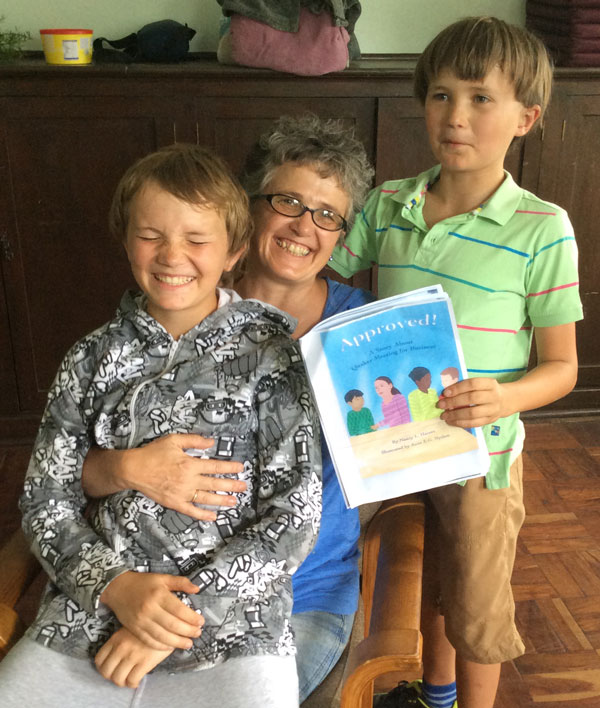
“Approved!” is reviewed by Amanda Gibberd, who can be seen above with Tusi and Pelo.

Approved! A Storey About Quaker Meeting for Business
by Nancy L. Haines
Illustrated by Anne E.G. Nydam

Book Review by Amanda Gibberd, Pretoria Worship Group

Approved! Is a short children’s – style book about the Quaker Business methods used in running Quaker Meetings for Worship for Business. It explains, using the children of a fictional meeting, how they run their own version of Meeting for Worship for Business, and how they reach decisions.

It describes a decision making process in a Children’s Meeting, explaining the roles of the clerk, treasurer and recording clerk along the way. With pictures. The book shows how the Business process runs rather than trying to explain it. The children learn about the adult Meeting by doing what the adults do.

The book ends with some children’s-style queries (or questions to think about), and a glossary of terms that explain some of the terminology, perhaps the everyday terminology that Quakers use and may forget that new comers do not understand. Or people who have been to Meeting for a long time and never really thought about what they mean by the words they use.

The book explains what discernment means. I had been wondering about what it meant, having spoken in Meeting about it. The description in this book is short and direct; “a way of listening to God and one another in order to sense what is the best decision for the community.” So now I know, and it’s a good definition.

My children haven’t read the book yet, but I am glad we now have it in our meeting. I remember growing up with the blue book and the red book in Quaker Meetings in England. The blue book was interesting. It had quotes of what people had said in 166-something, and I was touched by their depth and thoughtfulness. Then there was the red book which was boring and I never opened it. Neither had any pictures, but the red boring book explained Quaker business practice.

It wasn’t until much later, joining Young Friends, that I began to appreciated, enjoy and really participate in Quaker Business Meetings, although I don’t think I would have called them this at the time. They were just too much fun and a wonderful way to help you feel as if you could participate in making a meaningful impact on the world. There was no hierarchy; everyone had value. That value was contributed by each member and appreciated by the others in the Meeting. People took different roles in the Meeting but those that didn’t take roles also made valuable contributions to decision making. I loved my time on Quaker Committees, it helped to change my life, for the better.

The note at the end of the book explains that it has been written based on an actual children’s Meeting for Worship for Business that runs at Wellesley Meeting, Massachusetts, USA. It explains how the Meeting has managed to set up and run the Children’s Meeting for Worship for Business separate from the adult Meeting, with a belief that children are able to participate, and will learn through participation. It explains that Meetings do not always happen as the book describes, and it would be interesting to know more about how the mentors then deal with the situations that go wrong.

Our Meeting would be too small to set up a separate Meeting, but it may be worth us considering how we draw children into Business Processes. The book describes a different way of looking at children, not as the children that they are, but the adults that, with guidance, they could become.

In Meetings where many people are new to Quakerism it would be helpful to have a way of describing how business Meeting should run. Southern African Meetings have a wide range of attendance of people from a spiritually and culturally diverse background. Perhaps there is some use in us considering how we should explain Quaker Processes to everyone, including adults as well as to young people who are not yet involved, and children.

— Amanda Gibberd

Posted in Book Review, Publications, Quaker community | Leave a comment

Mid-Year Reps Meeting 2017

MYRM 2017 is coming up at the end of April. It will once again be held at Koinonia in Johannesburg. Please download, complete and return the Registration Form as a matter of urgency if you plan to attend. See the Events page for basic information.

Posted in MYRM | Leave a comment

BQM December 2016 Retreat

Posted in Meetings, Quaker community, Retreats, Spirituality | Leave a comment

World Quaker Day — 2 October; Quaker Week — 1-9 October

Britain Yearly Meeting is holding Quaker Week from 1-9 October, with the theme: Working together to build a better world. Their support material is on the BYM website.

FWCC is using the theme “Inspired by Faith, Witnessing the World”. They have a poster on this theme (see below). To download the high-resolution PDF file, click on the image. There is also a letter to Quakers and Meetings around the world, on their website.

fwcc-2016-wqd-poster-q-logo

Posted in Calendar items, Quaker community, Quaker history, Resources, World community | Leave a comment